
From Bodily Knowledge to Intuitive Movement (FBKTIM): An Introduction
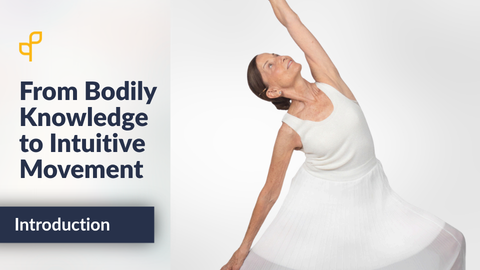
From Bodily Knowledge to Intuitive Movement (FBKTIM): An Introduction
1 hour
The instructors
Overview
This introductory conversation offers an orientation to my book, From Bodily Knowledge to Intuitive Movement: Where Physical Therapy, Yoga Therapy, and Pain Science Meet, and the experiences, influences, and evolving perspectives that shaped it.
I will share some of my personal injury experiences because their lessons became relevant and translatable through my background as a physical therapist and yoga therapist. Learning the power of presence changed my relationship with sensation. Our common tendency to tighten around sensation can become overprotective, often worsening the experience and leaving us feeling powerless. Instead, using sensation as a guide and recognizing the history within it delivers increasing clarity about how to proceed internally. We get to listen in, and that is where the healing occurs. With that, these experiences became some of my foundational templates: ways of seeing mine and others’ injuries and issues through more global, scientifically informed eyes.
I also share stories of some of my extraordinary mentors who, each in their own paradigm, taught me the enormity of learning by feel. They taught me that when experienced bodily knowledge and presence collude, what we learn cannot be unlearned and never stops evolving. Again and again, their lessons challenged whatever certainty I thought I had found in any technique or solution, and gradually I learned to “not know” and to “be taught” by my whole-being patients whom I felt privileged to work with.
This Introduction describes the unexpected confluence of my professional worlds. My physical therapy upbringing taught me to see the “whole body” through increasingly interconnected musculoskeletal relationships, connecting the kinesiological dots within movement.
Yoga therapy introduced the “whole person”: how our biological, psychological, social, and spiritual systems transect. Not surprisingly, this multilayered way of being with my patients was a relief, putting words to an underbelly of childhood lessons deeply absorbed but heretofore unarticulated.
At the recent APTA Combined Sections Meeting, Dr. Christopher Powers devoted his Mary McMillan Lecture to the importance of physical therapy reclaiming its place, with movement as its first therapeutic priority.
“Physical therapists are the essential providers of movement health across the lifespan,” he said. “The stakes are not merely professional; they are societal. When movement is poorly understood, health suffers. When disordered movement goes unaddressed, the costs are measured not only in dollars, but in pain, disability, and lost independence.”
I agree 100%.
And this is why when physical therapy and yoga therapy transect, their confluence becomes so compelling for me. Yoga therapy, as a self-awareness technology, offers access to the myriad bodily systems, including the psychological, social, and spiritual layers of being. In combination, these influence, sustain, and continually alter movement. Rather than pulling movement away from its center under the weight of everything we have learned about it in the literature, this wider lens may help us understand just how fully movement belongs at the heart of each body.
And if movement carries all that information, learning to feel it becomes that much more consequential.
Although technically driven, the book also contains a story. It has a beginning, a middle, and an end. The chapters are best read in order, as each builds upon what came before it.
Overview of the Book Chapters
Chapter 1 begins with the psychosocial and whole-person influences on movement, placing them alongside—and sometimes ahead of—anatomy.
Chapter 2 explores pain science and the experience of living with pain, including how beliefs, language, sensation, and context may influence that experience.
Chapter 3 introduces the engineering of movement and the personal movement system, giving us accessible ways to understand anatomy as it moves.
Chapter 4 uses gait, our most practiced movement, as a template for recognizing how our individual movement patterns travel with us, including onto the yoga mat.
Chapter 5 teaches us to see bodies without allowing anatomy to determine their stories, using bodily shapes and movement relationships as guideposts for curiosity and exploration.
Chapter 6 movement becomes increasingly guided from within. By then, structural understanding, bodily awareness, breathing, sensation detection, and felt experience can begin to work together until less needs to be consciously instructed. Movement becomes the meditation.
For a technical book, it is quite narrative — and, as you will see, so are the glossary and even the list of abbreviations. Both are truly designed for easy access. I wanted someone with no medical background to also have a way in. Bring a friend or a patient along in your mind, so that at any section you can ask yourself, “How would this apply to them?”
Get 15% off your purchase of the book by using the code: SBTRAIN155, which is valid on the Singing Dragon US website beginning now, with no end date. Here is the book page: From Bodily Knowledge to Intuitive Movement — Singing Dragon US
Learning Objectives
By the end of this introductory conversation, participants will be able to:
- Utilize the philosophy that integrates Physical Therapy, Yoga Therapy, and Pain Science throughout the course.
- Recognize how curiosity, observation, bodily awareness, and presence can cultivate greater personal agency.
- Understand how the course progresses from whole-person awareness toward increasingly individualized movement understanding and, ultimately, movement guided from within.
Audience
Physical therapists, yoga therapists, occupational therapists, movement educators, and curious readers who are happy to utilize the appendices for technical help.
Details and What's Included
This webinar is free for all to attend.
Registration includes:
- Access to the live webinar
- Live Q&A: bring your clinical questions
- Downloadable slides/resources
Continuing Education Units (CEUs) for U.S. PTs and PTAs
This introductory session is free and is not approved for CEUs.
CEUs are available through the paid series. Each of the six chapters is approved for 2 CEUs for U.S. PTs and PTAs in approved states, for 12 CEUs across the full series. You can register for individual chapters or for the complete series.
Register for the full FBKTIM series →
Full CEU details, including the states where Embodia is an approved provider and the states accepted via reciprocity, are listed on the series and chapter pages.
The instructors
PT, C-IAYT

C-IAYT
Gina Shelton, C-IAYT, is a pediatric yoga therapist with the Pain Management team at Cook Children’s Medical Center in Fort Worth. Gina works with outpatient persistent pain patients and hospitalized patients with GI pain, chronic headaches and migraines, epilepsy, cancer, eating disorders, cardiac issues, anxiety around treatment for injuries & accidents, as well as patients in intense neuro rehab.
Gina completed her yoga therapy program at Loyola Marymount University in 2010, and became a certified yoga therapist through International Association of Yoga Therapist in 2017. Gina was also the research & editorial assistant of the recently released book From Bodily Knowledge to Intuitive Movement: Where Yoga Therapy, Physical Therapy and Pain Science Meet by Sherry Brourman, PT, C-IAYT.